Lesson 1
Core Components of DeFi Infrastructure
The building blocks of a decentralized financial ecosystem.

Decentralized Finance, or DeFi, are financial systems without traditional intermediaries. At the heart of this transformation are foundational components, including stablecoins, decentralized exchanges (DEXs), and lending protocols, as well as additional innovations such as yield farming and staking, which expand what’s possible. These concepts power everything from payments and trading to credit and savings.
Each piece serves a unique purpose. For instance:
- Stablecoins are blockchain-based assets that enable both fast payments and price stability in the world of crypto. They are often pegged 1:1 to stable assets like the US Dollar.
- Decentralized Exchanges (DEXs) enable blockchain-based trading that’s trustless and secure.
- Lending protocols open up access to capital without credit checks.
- Yield farming enables users to earn passive income from their assets,
- Staking rewards long-term participants for helping secure a given blockchain network.
If these sound overwhelming, don’t worry, as we’ll simplify each one in turn in the coming chapters.
For now, understand that these tools are foundational, but they’re far from static. With AI innovation and blockchain upgrades (including notable enhancements on the XRP Ledger!),the DeFi landscape is evolving faster than ever.
Stablecoins: The Bedrock of DeFi
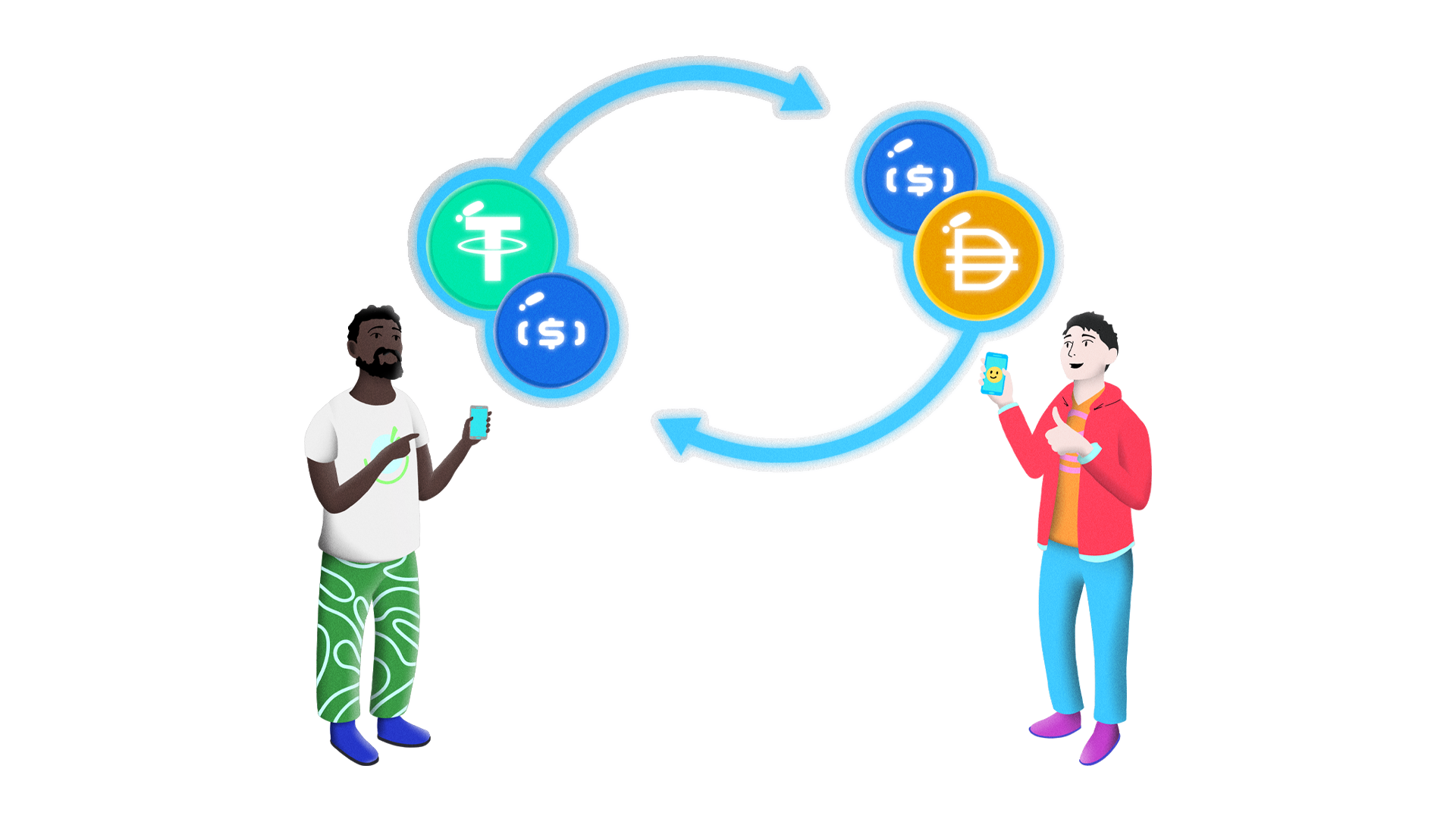
Stablecoins are cryptocurrencies whose value are pegged to fiat currencies, offering price stability in an inherently volatile crypto market. Prominent examples are USD-denominated and include USDT (Tether), USDC (Circle), and DAI (MakerDAO’s decentralized dollar). These are critical for trading, lending, and serving as collateral across DeFi platforms. That being said, it’s worth noting that other stablecoin currencies, such as the Euro, are growing quickly in market capitalization.
Not all stablecoins are/were created equal. Algorithmic models (stabilized by code and incentives) like Terra’s UST showed the risks of poorly designed systems when it collapsed in 2022. In contrast, fiat-backed coins (supported by real-world currency reserves) maintain reserves to ensure 1:1 value stability, making them the preferred choice for institutional adoption.
The XRP Ledger (XRPL) is emerging as a cornerstone in this maturing stablecoin landscape, thanks to its battle-tested infrastructure for fast (3-5 second finality), low-cost (sub-$0.01 per transaction) settlements and built-in compliance features (e.g, like the clawback for sanctions or credentials for KYC/AML verification).
Following the early 2025 additions of MiCA-compliant EURØP, USDB, and XSGD, the XRPL has continued to mature into a multi-currency stablecoin hub. Ripple’s NYDFS-regulated RLUSD went live in Q4 2024 and is already being used as enterprise-grade collateral in Ripple Prime. Shortly after, Circle’s USDC arrived, injecting over $120M in liquidity on the XRPL EVM Sidechain by September, representing a major catalyst for DeFi activity across the ecosystem.
These additions, along with new platforms built specifically for issuing regulated, multi-currency stablecoins on XRPL, have driven a sharp rise in stablecoin activity across the network. This growth mirrors the broader global surge in stablecoin adoption (up roughly 70–80% year-over-year), and highlights XRPL’s shift toward supporting tokenized real-world assets (RWAs) and programmable payments at scale.
Backed by ISO 20022 compatibility for traditional banking rails, multiple CBDC pilots, and native tools for permissioned lending and compliance, XRPL is evolving into more than a stablecoin host as it becomes a foundational settlement layer for regulated, cross-border digital currencies. This positions the ledger as a bridge between familiar fiat systems and high-speed global value flows in a market measured in the tens of trillions.

Stablecoin adoption is in part fueled by their various advantages, which include:
- Price stability: Access to dollar- or fiat-pegged value without exposure to crypto volatility.
- Global, instant transfers: Move money across borders in seconds, 24/7.
- Low fees: Send value at a fraction of traditional remittance or banking costs.
- Programmability: Automate payments, lending, and settlements using smart contracts.
- Interoperability: Use the same stable asset across DEXs, lending protocols, apps, and wallets.
- Accessibility: Anyone with a phone and internet can hold and transact in a stable currency.
- Transparency: Reserves and on-chain flows are auditable, unlike opaque banking systems.
- DeFi utility: Serve as collateral, liquidity, and settlement assets across decentralized finance.
As DeFi expands, seamless stablecoin integration on high-performance blockchains like the XRP Ledger is essential for unlocking scalability and global reach.
With growing demand for euro and regional currency support, stablecoin expansion is reshaping DeFi’s accessibility. XRP Ledger’s native support for multiple stablecoins in 2025 positions it as a multi-currency settlement layer, particularly attractive for enterprise-grade DeFi.
DEXs, Lending, and Liquidity
In traditional finance, trading exchanges match buyers and sellers through centralized order books, custodial accounts, and intermediaries who hold your assets on your behalf.
In DeFi, it’s decentralized exchanges (DEXs) that enable trading directly from user wallets, preserving self-custody and eliminating middlemen.
The two primary models are
- Automated Market Makers (AMMs): they work by pooling user token deposits together to create a liquidity pool from which users can trade in and out of. Pricing is algorithmically set based on supply and demand.yea
- Order-book DEXs: these resemble traditional trading platforms that match buyers and sellers, except it runs trustlessly on-chain.
A key innovation on the near horizon is the rise of permissioned DEXs,enabled by protocol upgrades like XRP Ledger’s v2.5.0 (released July 2025). These are tailored for institutions, allowing only verified, credentialed participants to trade specific assets while meeting regulatory requirements.
With its PermissionedDEX amendment now in validator voting, this protocol enhancement bolsters compliance through access controls and verified domains while preserving XRPL’s decentralized core.
Lending and borrowing in DeFi are largely powered by protocols like Aave and Compound. Users can lend assets to earn interest or borrow against collateral. Risks include liquidation if collateral values drop, but benefits include 24/7 access, no credit checks, and global reach.
AI is now also increasingly being integrated by various DeFi projects in significant ways. Aave, for example, has integrated AI for dynamic risk assessment, adjusting lending terms in real-time based on market and protocol data.

The Rise (and Risks) of Yield Farming
Yield farming lets users earn rewards by providing liquidity to protocols. In its simplest form, users deposit tokens into liquidity pools and receive returns in native tokens or fees.
More advanced strategies involve auto-compounding, as seen in platforms like Yearn Finance, whose smart contracts automatically reinvest earnings to maximize yield.
But yield farming isn’t without its pitfalls. Rewards can dry up, impermanent loss can erode profits, and rug pulls remain a risk in poorly audited protocols.
For example, say you deposit equal values of ETH and USDC into a trading pool. If ETH’s price suddenly doubles, the pool automatically shifts (“rebalances”) to keep things even for traders, so when you later withdraw your share, you’ll get back less ETH (and more USDC) than if you’d just held your original ETH. That’s impermanent loss—the hidden cost of price swings that can quietly chip away at your rewards, unless prices bounce back.

High promotional yield rates can mask risks from factors such as impermanent loss, which can pose a sustainability risk to protocols amid high overall market volatility. This is why sustainability and transparency are becoming increasingly significant concerns.
That being said, DeFi’s yield farming space is buzzing with AI integrations right now, especially for tackling the pain points highlighted above — sustainability via smarter risk assessment, transparency through real-time auditing, and optimization to counter impermanent loss or drying rewards.
Emerging platforms are leveraging artificial intelligence to analyze protocols, optimize capital allocation, and dynamically adjust positions in real time based on market conditions—tools increasingly tailored for efficient ledgers like XRPL, where AI agents can execute trades and manage risks with minimal friction.
These innovations are reshaping DeFi into a more efficient, intelligent system. The XRP Ledger, with its growing ecosystem and new protocol support, offers a low-fee, fast-settlement environment ideal for deploying yield strategies at scale.